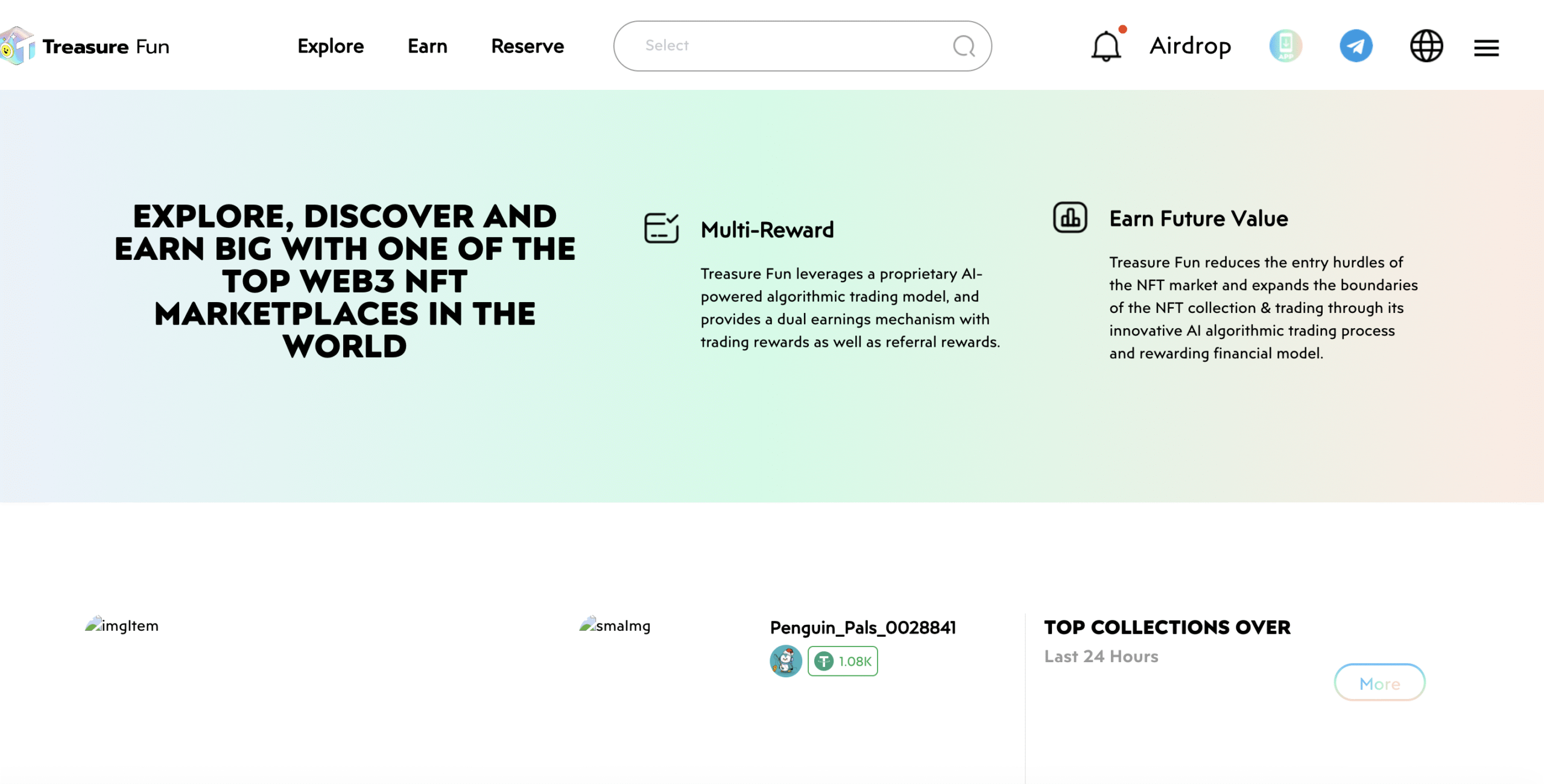
TreasureNFT.xyz does not look dangerous at first glance. It looks modern. Calm. Organized. It speaks in the language of digital assets and passive income, promising that users can earn predictable daily returns by “staking” NFTs through an automated system. There is no urgency in its tone, no obvious deception in its surface design. Everything feels measured, even professional.
That quiet confidence is what makes it effective.
Most fraudulent platforms fail by being too loud—too many promises, too much hype, too much pressure. TreasureNFT.xyz operates differently. It does not shout. It normalizes. It introduces itself as a tool, not a gamble. It offers a routine: deposit, watch numbers rise, withdraw occasionally, repeat.
This article does not rely on moral language or dramatic warnings. Instead, it maps five structural failure signals that appear consistently in systems designed to extract capital under the appearance of legitimacy. These signals are not unique to TreasureNFT.xyz. They appear in every long-running digital investment fraud. What makes TreasureNFT notable is how cleanly it exhibits all five.
The danger is not in any single claim. It is in the pattern.
Executive Summary
This report examines the operations and deceptive mechanisms of TreasureNFT.xyz, a platform that claims to offer NFT-based investment opportunities but has exhibited multiple signs of fraudulent behavior. Through analysis of its structure, marketing strategy, user complaints, and digital footprint, this review concludes that TreasureNFT.xyz functions as a Ponzi-style crypto scam, designed to exploit inexperienced investors by promising unrealistic returns and masking its true intent through rebranding and referral-driven recruitment.
This positioning is deliberate. It strips away the uncertainty that normally surrounds cryptocurrency markets and replaces it with routine. The experience is framed less like trading and more like participation in a managed system. Users are not asked to evaluate projects, read whitepapers, or understand blockchain mechanics. They are invited to activate an account and watch growth occur.
That framing matters. In legitimate crypto markets, risk is explicit. Volatility is expected. Even platforms that promise automation tend to show users how yield is generated—through staking, liquidity provision, arbitrage, or mining. TreasureNFT.xyz does not offer that context. The system is presented as self-contained. The mechanics are invisible by design.
The platform’s central claims typically include:
-
Fixed daily percentage returns
-
NFT “staking” or “holding” inside the platform
-
Tiered account levels with higher yield rates
-
Referral-based bonuses
-
A dashboard showing accumulating balances
These elements are familiar in the digital asset space. What distinguishes TreasureNFT.xyz is not the language, but the absence of verifiable structure behind it.
There is no public documentation describing how returns are produced. There are no contract addresses. No transaction hashes. No on-chain activity that can be independently verified. The NFTs users “purchase” exist only within the platform’s interface. They cannot be transferred to an external wallet or viewed on a public marketplace. Their value is defined solely by the platform itself.
This creates an unusual dynamic. The system behaves like a market but does not connect to one. It displays growth but does not expose its source. The user’s experience is complete within the site. Once funds enter, they are converted into internal balances that follow the platform’s own rules.
In traditional finance, even closed systems have external anchors. A bank account maps to a regulated institution. A brokerage account maps to custodial assets. A crypto wallet maps to a public ledger. Here, the mapping stops at the interface.
The question is not whether this design is unconventional. Many platforms abstract complexity. The question is whether the abstraction is reversible. Can a user independently verify that the assets displayed correspond to anything outside the platform’s own database?
In TreasureNFT.xyz, the answer appears to be no.
That alone does not prove misconduct. It does, however, define the system’s dependency: everything works only as long as the platform itself continues to operate and honor its internal numbers. There is no external enforcement layer. No automated settlement. No immutable record.
What follows from that design is a different kind of risk. Not market risk, but structural risk.
Market risk is unpredictable.
Structural risk is binary.
Either the system continues, or it doesn’t.
The First Friction: Where Yield Comes From
The platform’s core promise is consistent daily return. In crypto markets, such stability is rare. Even large-scale staking protocols fluctuate. Even algorithmic strategies experience drawdowns.
TreasureNFT.xyz does not frame its yield as variable. Percentages are shown as fixed. Time becomes the only input. The longer funds remain in the system, the more they grow.
What is missing is any mechanism tying those returns to external activity. There is no indication of:
-
NFT trading volume
-
Counterparties
-
Market exposure
-
Liquidity pools
-
Network validation
-
Arbitrage strategies
The yield appears to be an internal calculation.
That design creates a closed economic loop. New deposits become the system’s only observable inflow. All “profit” is denominated in balances that exist only inside the platform.
In such a structure, sustainability depends on one condition: inflows must exceed outflows.
This is not an accusation. It is a mathematical property.
If a system generates no external revenue, then every payout must be funded from existing deposits. The moment withdrawals exceed new entries, the loop breaks.
That is not speculation. It is arithmetic.
Interface as Authority
TreasureNFT.xyz relies heavily on its interface to establish legitimacy. The dashboard is clean. Numbers update smoothly. The experience resembles fintech products users already trust.
This is effective. Most people assess credibility visually. A platform that looks professional feels professional. Few users expect that the absence of a blockchain explorer or contract address is itself meaningful.
Yet in crypto environments, the ability to inspect underlying activity is not optional. It is foundational.
A wallet balance can be verified.
A transaction can be traced.
A contract can be audited.
TreasureNFT.xyz offers none of these affordances. The system is observational, not inspectable. Users can see outcomes, but not causes.
That distinction becomes critical when things go wrong.
If a withdrawal is delayed, there is no ledger to check.
If a balance changes, there is no transaction to verify.
If a feature disappears, there is no record of its prior state.
Everything depends on the platform’s own reporting.
In effect, the interface becomes the authority.
Early User Experience Patterns
Accounts from participants follow a consistent arc.
The entry barrier is low. Initial deposits are modest. Early balances grow on schedule. In some cases, small withdrawals are processed without incident. This reinforces trust. It creates a sense that the system “works.”
Over time, users are encouraged to:
-
Upgrade account tiers
-
Increase deposits
-
Invite others
The system rewards continuity. The longer one remains, the more efficient the returns appear. The referral structure transforms users into distributors. Growth becomes social.
This is not unique to TreasureNFT.xyz. Many digital platforms use network effects. The difference lies in what the network produces.
Here, the network does not produce content, liquidity, or computation. It produces deposits.
And deposits are the only observable resource.
The Role of Education Gaps
One of the system’s quiet advantages is that many users do not know what to expect from a legitimate crypto product.
For first-time participants, the absence of on-chain visibility does not register as unusual. The interface feels complete. The experience feels modern.
Yet in established crypto practice, users are taught to verify:
-
Wallet addresses
-
Contract deployment
-
Transaction history
-
Network fees
-
Settlement times
TreasureNFT.xyz removes the need for that literacy. It replaces verification with convenience.
This is not accidental.
A user who cannot compare a platform to known standards has no baseline. Everything feels plausible.
Resources that outline how legitimate platforms expose their structure exist precisely because this knowledge gap is common. A practical example is the industry-standard process for verifying whether a platform is technically real. TreasureNFT.xyz offers none of those affordances. There is no way to confirm that any asset shown inside the interface corresponds to a public network, a contract, or even a ledger. That absence is not cosmetic. It is structural.
The Fragility of Self-Contained Economies
Closed systems can function for long periods if growth is steady. They fail when growth slows.
The moment deposits plateau, the system must choose between:
-
Reducing payouts
-
Delaying withdrawals
-
Changing terms
-
Restricting access
Each option erodes confidence.
Because TreasureNFT.xyz does not expose its mechanics, it cannot explain change in market terms. It cannot say, “Returns are lower because volume dropped.” It has no such metric.
Instead, change must be procedural.
More steps.
Longer waits.
New conditions.
Over time, the interface that once signaled efficiency begins to signal friction.
That transition is gradual. It is rarely announced. It is experienced individually.
And because it is experienced individually, it is often doubted.
Users ask themselves:
-
Is this just me?
-
Did I do something wrong?
-
Is this temporary?
The system benefits from that uncertainty.
Where Education Interrupts the Cycle
The most effective disruption is not exposure. It is comparison.
When users understand what legitimate platforms provide—verifiable ledgers, public contracts, auditable mechanics—the absence of those elements becomes visible.
Guides that outline how authentic crypto services expose their operations, such as frameworks for verifying digital platforms, exist precisely because this distinction is not intuitive. Without that reference, a sealed interface feels complete.
Understanding the behavioral arc that follows platform instability—what happens after access becomes conditional, after timelines become fluid—changes interpretation. The pattern is consistent across closed crypto systems and is documented in analyses of what users typically experience after a platform begins to stall. Delay becomes normalized. Communication becomes cyclical. Users are left individually waiting inside a system that no longer resolves outward.
The Absence of External Pressure
Traditional financial systems fail under scrutiny.
They are audited.
They are regulated.
They are litigated.
Closed-loop digital platforms fail under entropy.
They are not dismantled.
They are abandoned.
Because they do not anchor to jurisdiction, there is no formal shutdown. Because they do not anchor to public ledgers, there is no final transaction. Because they do not anchor to identity, there is no accountable party.
They simply stop being where they were.
This absence of external pressure is not a loophole. It is the design space.
Cryptocurrency enables permissionless systems. That property is neutral. It enables innovation and abuse with equal efficiency. The difference lies in whether a platform exposes itself to verification.
TreasureNFT.xyz does not.
What the Platform Reveals About Its Own Limits
Every system communicates its constraints.
TreasureNFT.xyz communicates through:
-
Internal-only assets
-
Fixed-yield promises
-
Conditional exit
-
Mutable identity
-
Opaque operation
These are not marketing choices. They are structural.
They tell us:
-
The platform cannot tolerate full transparency
-
It cannot guarantee long-term liquidity
-
It cannot bind itself to jurisdiction
-
It cannot expose its mechanics
-
It cannot persist under scrutiny
That does not require intent. It requires only design.
Systems built this way do not fail because someone intervenes.
They fail because growth slows.