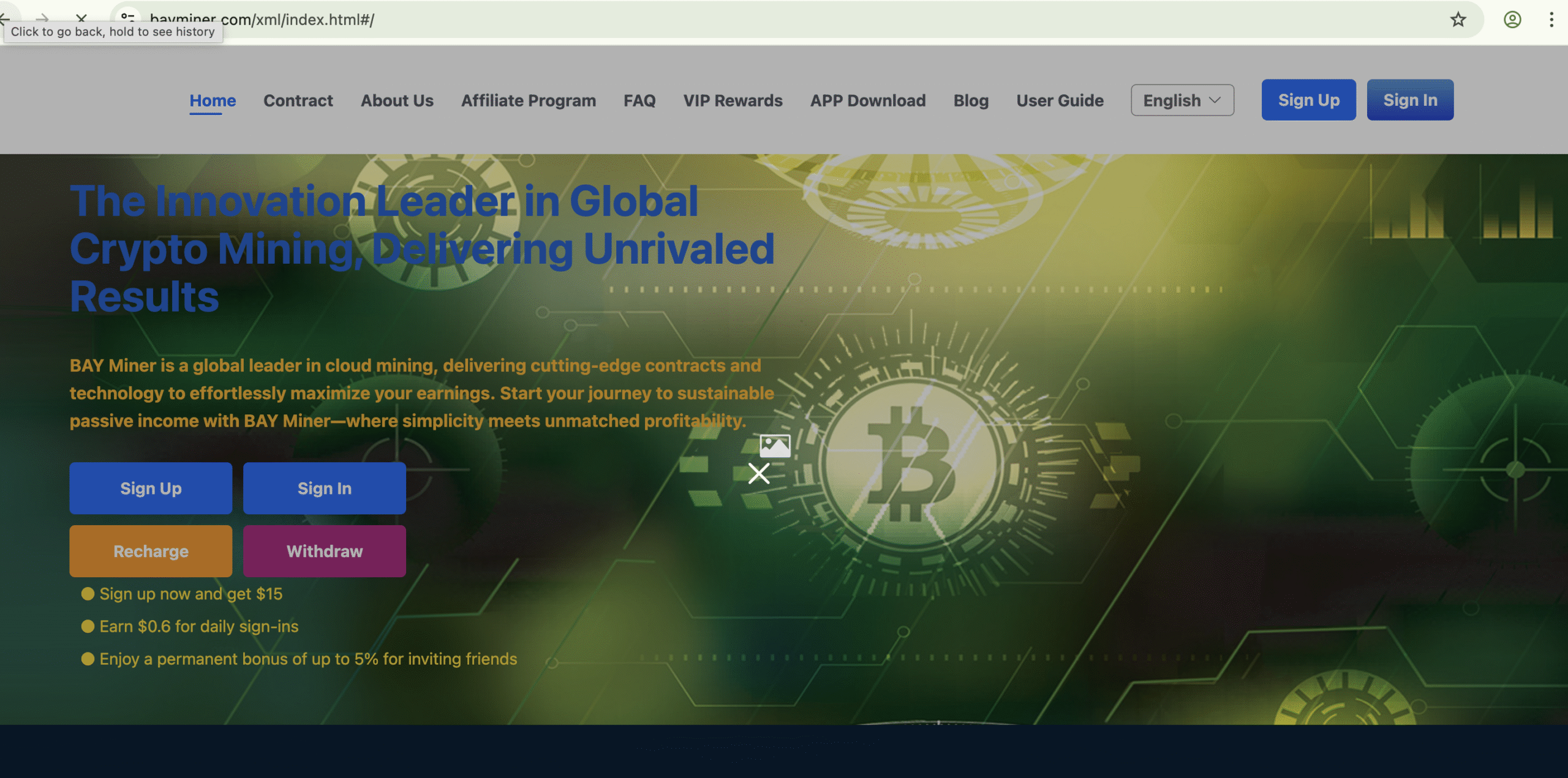

In the world of cryptocurrency investment and cloud-mining offers, platforms promising high, stable returns almost overnight are common. One name that has surfaced repeatedly – and with serious warnings attached – is Paladin Mining (the website: paladinmining.com). While the site presents itself as a legitimate “cloud mining” service, multiple reports and independent analyses strongly suggest that it is a high-risk or outright fraudulent operation.
In this article, we’ll walk through: what paladinmining.com claims to do; the red flags associated with it; real user experiences; how the scheme appears to be structured; and why it poses a significant risk to potential investors.
Digital finance has made it easy for platforms to look authoritative. A polished dashboard, confident language, and a few performance charts can give the impression of industrial-scale operations running somewhere behind the screen. In the crypto space, that illusion is powerful. It turns complex infrastructure into a simple story: deposit, wait, withdraw profit.
Paladinmining.com fits neatly into that narrative.
It introduces itself as a cloud-mining service—an intermediary between users and vast mining farms. The promise is effortless participation in cryptocurrency generation. No hardware. No electricity bills. Just a plan, a deposit, and daily returns. It sounds like a shortcut into a technical world.
The problem is not the idea. Cloud mining exists. The problem is what happens when the story is inspected.
What follows is not an accusation-driven teardown. It’s an examination of how Paladinmining.com behaves, how users describe their experiences, and how those patterns compare with the mechanics of real mining operations. The aim is clarity, not drama.
A Business Model Built on Simplicity
Paladinmining.com presents a set of “plans” that users can purchase. Each plan suggests a defined return over time. The interface is clean. The entry point is low. New accounts see balances grow almost immediately.
The pitch is frictionless:
-
Buy a contract
-
Watch daily earnings accrue
-
Withdraw at will
-
Earn bonuses for referrals
This simplicity is part of the attraction. Mining, in reality, is resource-intensive and volatile. Here, it is packaged as a subscription.
Yet every legitimate mining operator faces three unavoidable variables: hardware cost, energy expense, and network difficulty. These shift constantly. Any platform claiming stable, predictable output must either absorb those fluctuations or simulate them.
Paladinmining.com does not explain how it absorbs risk. It simply removes it from the story.
Where the Picture Starts to Blur
When investors look beyond the dashboard, the external footprint is thin.
There is no visible leadership team with verifiable histories. No published facility locations. No energy partnerships. No audit statements. No independent performance records. The operation exists almost entirely inside its own interface.
This absence is not proof of wrongdoing. Some firms remain private by design. But in capital-intensive industries, invisibility carries consequences. Mining requires scale. Scale leaves traces—permits, suppliers, photos, reports, staff.
Here, the trail fades.
The site compensates with reassurance. Contracts are framed as reliable. Payouts appear consistent. The system feels stable. That stability becomes the evidence.
But stability can be simulated.
Patterns from the Field
User accounts form the most revealing layer.
A recurring theme emerges:
-
Early deposits generate visible earnings.
-
Small withdrawals succeed.
-
Confidence builds.
-
Larger contracts are encouraged.
-
New conditions appear.
-
Withdrawals stall.
-
Additional purchases are required to “unlock” access.
This arc mirrors a well-known structure. Early liquidity functions as credibility. Later friction converts confidence into dependency.
Some users report that contracts are not self-contained. Progress requires “batch completion” or “level upgrades” that were not emphasized at the start. Others describe sudden technical barriers, policy changes, or support silence once balances reach meaningful size.
The common outcome is not volatility—it is inaccessibility.
Why the Model Conflicts with Reality
Real mining output fluctuates. It responds to:
-
Hashrate competition
-
Energy pricing
-
Hardware efficiency
-
Network adjustments
-
Market conditions
A platform offering uniform daily yields must either subsidize losses or fabricate returns. Sustained guarantees in such an environment are structurally improbable.
Legitimate operators publish:
-
Hashrate statistics
-
Facility details
-
Energy sourcing
-
Pool affiliations
-
Audit summaries
Paladinmining.com substitutes those with internal numbers only it controls.
The distinction matters. A ledger you cannot verify is not a record—it is a display.
The Review Economy Problem
Search results around Paladinmining.com are crowded with praise. Many posts follow similar structures. Similar phrasing. Similar timing.
This is not unusual. Reputation markets are easy to influence. Template reviews create volume. Volume creates credibility.
Negative experiences, by contrast, are scattered across forums and comment threads. They are less polished. More specific. Often written in frustration.
In financial ecosystems, asymmetry of voice is itself information. When professional optimism overwhelms personal narrative, skepticism is healthy.
A Practical Framework for Evaluation
Platforms like this do not collapse in one moment. They fade through friction.
A careful investor treats that friction as data.
Before engaging any service claiming operational infrastructure:
-
Demand evidence that exists outside the platform
-
Confirm who holds custody of funds
-
Ask where physical operations are located
-
Request third-party verification
-
Compare claims with industry norms
Most importantly, to verify a platform’s credibility before transferring funds. Authority should be external, not self-declared.
When answers remain abstract, that abstraction is part of the product.
When the Story Changes
The most difficult moment for users is not the initial decision—it is the shift.
The platform that once felt smooth becomes conditional. Rules evolve. Access narrows. Support grows slow. New steps appear between balance and withdrawal.
This is the moment when confusion turns into consequence.
understanding what to do after financial deception can determine whether losses become permanent or recoverable. becomes essential, because delay often cements loss. Digital systems move faster than dispute processes. Preparation matters.
A Wider Context
Paladinmining.com is not unique. It belongs to a class of platforms that thrive in the gap between appearance and infrastructure.
Modern design compresses that gap. A convincing interface now costs less than a single mining rig.
That inversion changes risk. It shifts evaluation from surface to structure.
The investor who once asked, “Does this look professional?” must now ask, “Can this exist without belief?”
If the answer is no, belief becomes the asset being mined.
Where This Leaves the Decision
There is no public evidence that proves malicious intent. There is also no independent evidence that proves operational reality.
What exists is a closed loop:
-
Claims originate from the platform
-
Metrics are generated internally
-
Trust is built through early access
-
Barriers appear later
In finance, that loop is fragile.
Risk does not always announce itself. Sometimes it behaves politely. It rewards patience. It encourages scale. It delays consequence.
Until a system can be validated beyond its own narrative, participation remains speculative.
Paladinmining.com offers a story of effortless yield. What it has not offered is a verifiable engine behind that story.
In markets built on computation and capital, stories are easy.
Proof is harder.
And money deserves proof.