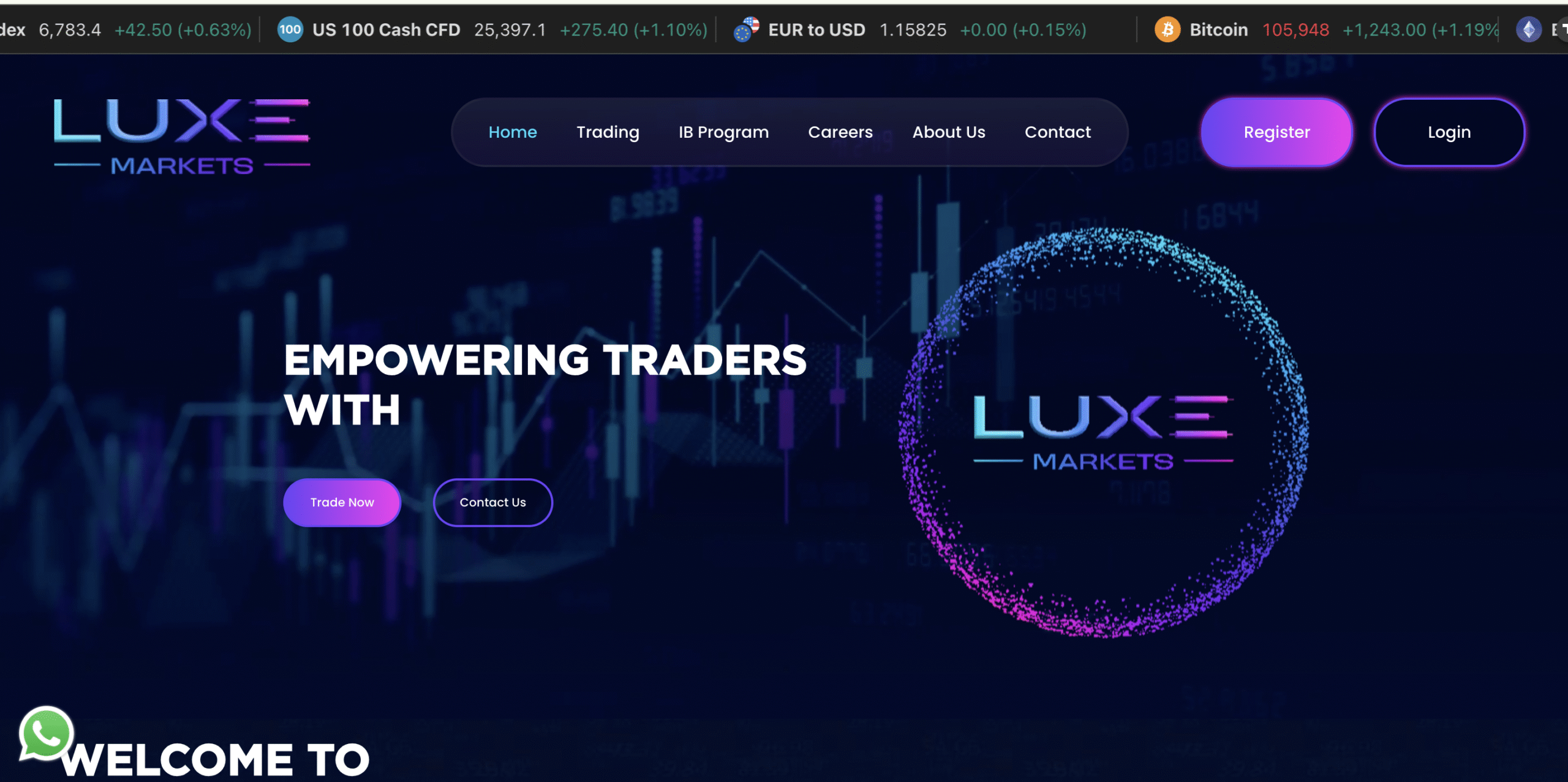
This review delves into what Luxemarkets.forex claims to offer, the patterns observed from user experiences, the regulatory and operational red flags, and why this platform may pose a serious threat to traders’ funds. Understanding these issues is crucial for anyone considering online trading, particularly with new or unverified brokers.
In online trading, appearance often substitutes for substance. Platforms invest heavily in dashboards, terminology, and interfaces that resemble professional environments. What’s harder to manufacture is accountability. Luxemarkets.forex presents itself as a polished gateway into forex and CFD trading, but beneath its clean surface are structural gaps that leave traders exposed in ways they rarely notice at first.
This is not a story about dramatic collapse or instant loss. It’s about subtle erosion: policies that favor the house, systems that shift without warning, and a framework that places all leverage—legal, technical, and operational—on one side of the screen.
What follows is an analytical walkthrough of seven blind spots embedded into Luxemarkets.forex’s operation. These aren’t bugs. They are design choices.
The Broker Illusion
Luxemarkets.forex promotes itself as a global trading provider. The platform features common industry signals: account tiers, leverage settings, trading instruments, and familiar software branding. To a new trader, this resemblance creates comfort. It feels like stepping into a room that already exists elsewhere.
But resemblance is not equivalence.
There is no public trail tying Luxemarkets.forex to a regulated financial authority. No verifiable license. No registry entry under a recognized supervisory body. What exists is branding—professional in tone, ambiguous in detail.
This distinction matters. Regulation isn’t cosmetic. It governs how funds are held, how disputes are resolved, and what recourse exists when something breaks.
Without it, every promise becomes optional.
Blind Spot 1: Regulation That Exists Only in Language
Luxemarkets.forex refers to compliance frameworks in its documentation. The phrasing resembles that of legitimate brokers: “risk disclosures,” “client protection,” “trading terms.” These are familiar words. But words are not enforcement.
A regulated broker operates under audit. It cannot invent rules after the fact. It cannot deny access to capital without consequence. It must explain itself to an external authority.
Luxemarkets.forex answers only to itself.
This means:
-
Trading conditions can change without warning
-
Accounts can be frozen under internal policy
-
Withdrawals can be delayed indefinitely
-
There is no external body to escalate disputes
The user agreement grants the platform wide discretion. What appears to be protection language functions instead as insulation.
Blind Spot 2: The Withdrawal Mirage
Depositing funds into Luxemarkets.forex is smooth. Payment channels are varied. The interface guides the user efficiently from registration to funding.
Withdrawing is another story.
Across user reports, a consistent narrative emerges: requests trigger “verification cycles,” “technical reviews,” or “compliance checks.” Time stretches. Communication slows. Requirements expand.
This pattern is not random. It’s structural.
A system that prioritizes intake but complicates exit creates an asymmetry. Funds flow inward easily. Outward movement becomes conditional.
Some traders are allowed small withdrawals early. This builds confidence. Larger attempts encounter friction.
The architecture trains patience while exhausting resistance.
Blind Spot 3: Bonuses That Rewire Control
Luxemarkets.forex promotes account incentives—deposit bonuses, promotional balances, leverage enhancements. These are framed as advantages.
What’s often hidden is the mechanism: bonuses are not gifts. They attach conditions.
Common effects include:
-
Profit thresholds tied to bonus volume
-
Withdrawal restrictions until turnover metrics are met
-
Automatic forfeiture clauses
-
Ambiguous eligibility definitions
A trader may believe they are withdrawing their own capital or gains. The system may define those funds as “entangled” with promotional balance.
The result is a technical trap: capital becomes conditional after it is already inside the platform.
Blind Spot 4: Interface as Authority
The dashboard becomes the reality.
Balances update. Trades appear closed. Equity grows. The interface behaves like every other trading environment.
But unlike regulated brokers, Luxemarkets.forex is not required to mirror actual market execution. There is no public audit. No third-party confirmation of liquidity routing.
This creates a closed ecosystem:
-
Prices can be internalized
-
Execution parameters can shift
-
Slippage can be explained post hoc
-
Performance metrics cannot be externally verified
The user sees numbers. The system defines what those numbers mean.
Many fraudulent operations rely on this architecture. Not by breaking visibly, but by becoming unchallengeable.
When traders first encounter a platform like Luxemarkets.forex, the warning signs are rarely obvious. Many of the patterns align with what analysts describe in this guide on
how fake investment websites structure themselves to look legitimate—from polished dashboards to vague legal language designed to appear compliant without offering real protection.
Blind Spot 5: The Elastic Rulebook
Luxemarkets.forex’s terms reserve broad rights:
-
To modify conditions
-
To interpret “abuse”
-
To cancel positions
-
To suspend accounts
These clauses are framed as safeguards. In practice, they form an elastic perimeter.
A trader may believe they are operating within parameters. The platform retains the authority to redefine those parameters retroactively.
This is especially potent during withdrawal attempts. Actions that were previously allowed may be reframed as violations. Profits may be labeled “irregular.” Activity may be flagged as “non-standard.”
The rulebook moves.
Blind Spot 6: Communication as Delay Architecture
Support channels exist. Replies are polite. Explanations are procedural.
But they follow a pattern:
-
Acknowledge the issue
-
Request documentation
-
Escalate internally
-
Ask for patience
-
Restart the cycle
Each loop consumes time. Each step repositions responsibility away from resolution.
The user remains engaged. Hope persists. Capital remains in-system.
This is not a broken support structure. It is a stabilizing mechanism. It keeps the trader participating without restoring control.
Blind Spot 7: Isolation by Design
Regulated platforms operate within ecosystems: ombudsmen, oversight bodies, reporting frameworks.
Luxemarkets.forex exists in isolation.
A trader encountering difficulty has limited options:
-
Internal support
-
Email escalation
-
Silence
There is no external authority to pressure the platform. No licensing body to investigate. No public registry to appeal.
The trader’s leverage exists only inside the system that holds their funds.
This is not merely inconvenient. It redefines the balance of power.
Why These Systems Persist
Platforms like Luxemarkets.forex are not built for immediate collapse. They are built for endurance.
They function because:
-
Most users do not withdraw immediately
-
Early interactions appear normal
-
Technical language creates perceived legitimacy
-
Delay diffuses urgency
-
Isolation limits escalation
Each layer absorbs friction. Each blind spot reduces resistance.
The platform does not need to deceive everyone. It needs only to outlast the moment when control is challenged.
Navigating the Aftermath
Some traders realize the structure only after funds are inside. The interface no longer feels neutral. Requests become complicated. Communication changes tone.
For traders who have already deposited funds and are now facing blocked withdrawals or unexplained account restrictions, there is still a narrow window to respond strategically. You can
request a private recovery consultation
to understand what options remain before the trail goes cold.
This is not about guarantees. It is about restoring agency before the system finishes closing.
Reframing Risk in Online Trading
Luxemarkets.forex illustrates a broader issue in retail trading: platforms are not neutral intermediaries by default.
Risk is not confined to market volatility. It includes:
-
Custodial control
-
Policy discretion
-
Technical opacity
-
Jurisdictional ambiguity
A trader can manage market exposure. They cannot hedge against structural imbalance.
True due diligence means asking:
-
Who governs this platform?
-
Who holds authority over funds?
-
Who resolves disputes?
-
Who answers when something fails?
If the answer to all four is “the platform itself,” the trade is no longer about markets. It is about trust architecture.
Final Assessment
Luxemarkets.forex does not fail loudly. It operates quietly. It invites participation through familiarity and retains advantage through asymmetry.
The seven blind spots outlined here are not accidents. They are systemic:
-
Regulation exists only in language
-
Withdrawals are structurally complicated
-
Bonuses entangle control
-
Interfaces replace verification
-
Rules remain elastic
-
Support systems absorb time
-
Isolation eliminates leverage
Each one shifts risk away from the platform and onto the trader.
In online trading, danger rarely announces itself. It embeds. It feels procedural. It looks normal.
And by the time it becomes visible, the exit is no longer simple.
Luxemarkets.forex is not defined by what it claims. It is defined by what it withholds.