
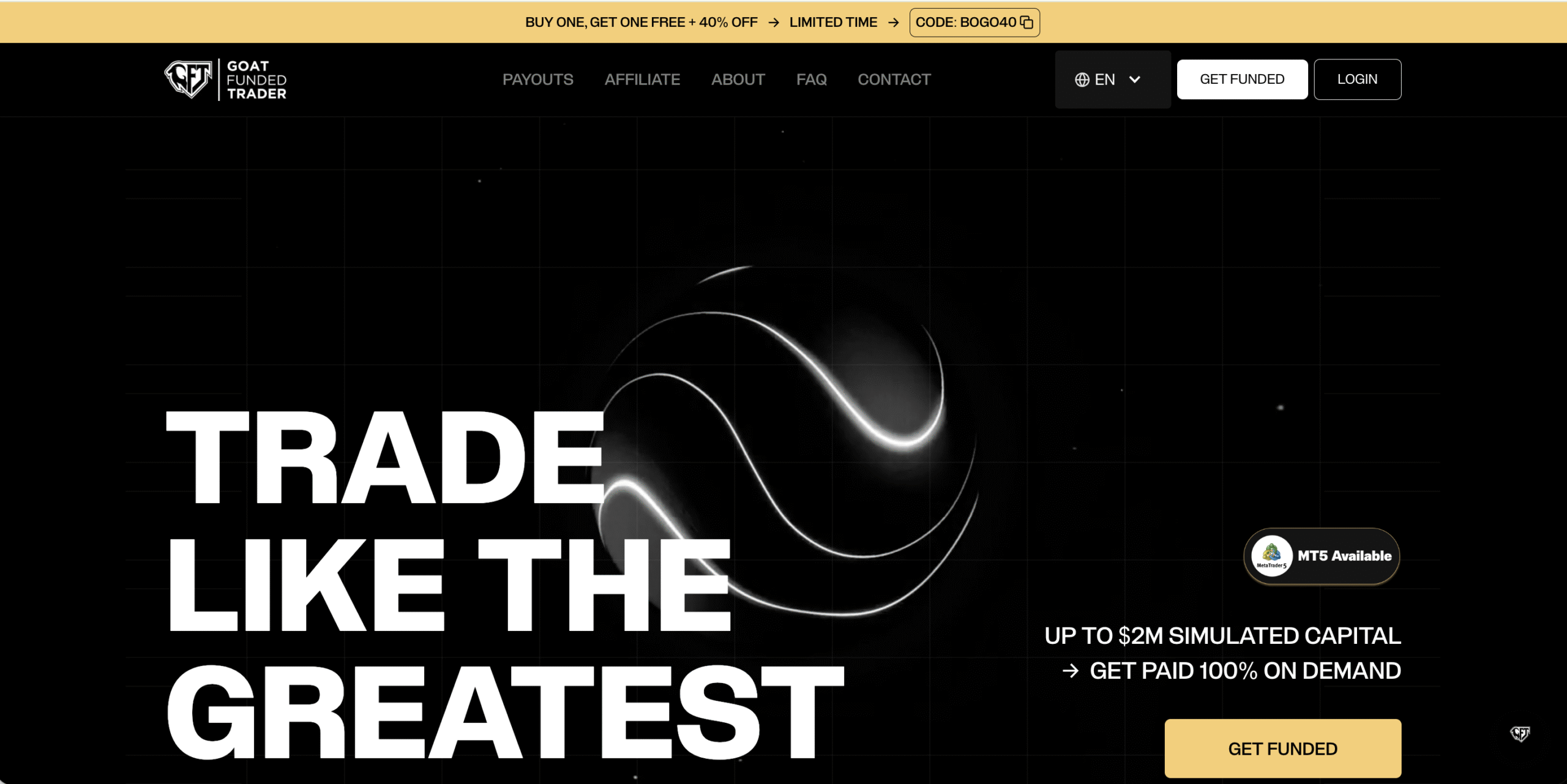
In the rapidly growing world of proprietary trading firms (prop firms) that offer “funded accounts,” GoatFundedTrader.com has emerged as one of the more talked‑about names. The promise is simple and appealing: pay a relatively modest fee, pass an evaluation phase under predefined rules, then trade with large firm capital and keep a large share of profits. However, many traders have voiced serious concerns about the reality behind GoatFundedTrader.com. Are you getting a genuine opportunity — or are you entering a setup designed mostly to extract fees and deliver frustration? In this review we dig deep into GoatFundedTrader.com: its business model, user‑feedback, warning signs, and a verdict on whether it should be considered a scam or simply high‑risk.
What Is GoatFundedTrader.com?
GoatFundedTrader.com presents itself as a proprietary trading firm that funds traders after they successfully complete an evaluation phase (often called a “challenge” or “instant account”). Here’s the usual flow offered:
-
Evaluation / Instant Account Phase
A trader pays a fee to open an evaluation challenge under the rules set by GoatFundedTrader.com. Typically, the rules cover things like: achieve a profit target, stay under a maximum drawdown, trade for a number of days, keep within consistency rules. If you pass, you move to phase two. -
Funded Account Phase
If you pass the challenge, GoatFundedTrader.com claims to give you “firm capital” to trade. You keep a portion of the profits (the trader’s share) while the firm shoulders the capital risk. On its website, GoatFundedTrader.com advertises “Get Funded up to 800 k with a payout split up to 95% on your side.” (via their Trustpilot profile page).
They also claim to support multiple account sizes and types (Instant, Classic, No Time Limit etc), enabling you to scale up.
For many traders, the appeal is obvious: you pay a modest fee, you don’t need your own large capital, you trade large sums, and you collect profits. On paper this sounds great. But as always, the question is: do the terms hold true in practice? And are those “modest fees” and rules actually fair and transparent? That’s where the complications come in.
What Are Traders Saying? A Mixed Bag
The user feedback across review platforms, Reddit threads, forums and independent sites show a mixed picture for GoatFundedTrader.com. Some traders report positive experiences, but many raise serious concerns. Below is a breakdown of the two sides.
✅ Positive Feedback
-
On Trustpilot (UK version) for GoatFundedTrader.com there is a 3.5 out of 5 score from over 3,200 reviews. Many traders praise the support team and the ease of initial registration and verification.
Example: “The support team is so responsive and awesome… they make you feel safe.” -
Some traders say they received payouts from GoatFundedTrader.com and found fewer obstacles than other prop firms: “I had a small deduction for going over the news cap, but they explained it clearly and still processed my payout fast.”
-
On some independent ratings (e.g., Scams2avoid.com), GoatFundedTrader.com shows an average rating from some users.
-
Some traders appreciate the lower entry cost compared to larger, more established prop firms, and welcome the comparatively accessible “Instant account” options.
These positive experiences suggest that GoatFundedTrader.com does operate a functional platform, issues accounts, and in some cases pays traders. That alone makes it different from obvious fraudulent operations that simply vanish or never pay anyone. But the positive side is only half of the story.
The funded-account boom has reshaped retail trading. What once required years of compounding now appears within reach after a single checkout page. Proprietary firms promise capital, leverage, and status in exchange for a relatively small entry fee. The model feels modern, efficient, and empowering.
GoatFundedTrader sits squarely inside that narrative.
At first glance, the offer looks elegant: pass a challenge, trade firm capital, keep most of the upside. The interface is clean. The pricing is approachable. The language suggests access rather than exclusion. Many traders arrive believing they are stepping into a merit-based system.
But platforms don’t reveal themselves through slogans. They reveal themselves through friction—where it appears, how it’s framed, and who ultimately bears it.
This article doesn’t try to decide whether GoatFundedTrader is “legit” or “fake.” It treats it as a system and asks a more practical question:
What behavior does this platform reward, and what does it quietly penalize?
The Architecture of Entry
The first experience with GoatFundedTrader is frictionless by design. The purchase flow is short. The account is created quickly. The trader is moved into action almost immediately.
This speed does two things:
-
It minimizes hesitation.
-
It reframes the fee as an “opportunity ticket” rather than a business transaction.
Instead of feeling like a customer buying a service, the user begins to feel like a candidate stepping into an arena. That shift is subtle but powerful. It changes expectations. Losing the fee starts to feel like personal failure rather than a commercial outcome.
The platform benefits from that reframing. The risk becomes emotional, not contractual.
Where Rules Become Environment
Every prop firm runs on rules. That isn’t unusual. What matters is how those rules behave over time.
With GoatFundedTrader, a recurring pattern appears in trader narratives: the sense that the rulebook is not a fixed document but a living environment. Limits on drawdown, daily loss, trade duration, or profit concentration may be technically present, yet only become meaningful when a trader approaches payout.
For some, that moment arrives with surprise:
-
A day’s profit is suddenly considered “too dominant.”
-
Equity-based drawdown behaves differently than expected.
-
News-related losses invalidate an otherwise compliant run.
None of these mechanisms are inherently unfair. What unsettles traders is their timing. Rules feel abstract when reading a PDF. They become decisive when a payout is at stake.
A system where constraints reveal their full weight only at the moment of success creates asymmetry. The trader carries performance risk. The firm carries interpretive power.
Marketing as Expectation Engineering
GoatFundedTrader’s public language leans aspirational:
-
Large account sizes.
-
High profit splits.
-
Low barriers to entry.
These elements shape a mental picture long before the first trade is placed. The trader imagines a trajectory: small fee → challenge → scale → consistency → income.
But platforms don’t operate on imagination. They operate on execution.
The tension arises when the lived experience doesn’t match the mental model created by promotion. Complaints about advertised pricing that changes at checkout, or about “no hidden rules” colliding with newly enforced conditions, are not just transactional disputes. They are narrative fractures.
The trader didn’t simply buy a product. They bought a story.
When that story bends, trust doesn’t fade gradually—it snaps.
Execution and the Invisible Layer
Several user accounts describe trades closing beyond expected loss parameters, particularly during volatile moments. Stops that should cap exposure appear to slip. Accounts fail. Appeals are met with explanations rather than logs.
Here, the problem isn’t whether slippage exists. It always does.
The problem is opacity.
In traditional brokerage environments, execution paths can be audited. Liquidity providers can be identified. Disputes have reference points. In a prop-firm simulation environment, that chain is internal. The platform becomes referee and counterparty at once.
When a trader cannot independently verify how a loss occurred, the environment changes. The platform ceases to feel neutral. It begins to feel interpretive.
Understanding how funded firms are independently verified helps clarify the difference between external oversight and internal arbitration. GoatFundedTrader operates in the latter mode.
That doesn’t make it malicious. It does make it structurally dominant.
Payout as a Psychological Threshold
The funded-account model builds toward a single emotional peak: the first withdrawal.
Everything before it feels preparatory. Everything after it feels real.
This is where many tensions concentrate.
Some traders describe:
-
Delays that were not mentioned during onboarding.
-
Caps on first withdrawals that were not central in marketing.
-
Additional conditions that feel retroactive.
Again, the issue is not that limitations exist. It’s that their prominence increases only when money is about to move out of the system.
From the platform’s perspective, this is risk management.
From the trader’s perspective, it feels like a moving horizon.
A system that accelerates entry and complicates exit creates imbalance. The trader’s effort compounds. The platform’s exposure remains contained.
The Economics Beneath the Interface
Prop firms are not banks. They are not brokers. They are businesses built around participation volume.
Most traders fail challenges.
Many pay multiple times.
A smaller fraction reach funded status.
An even smaller fraction withdraw consistently.
This is not a flaw. It is the business model.
The question is whether the platform’s structure allows genuine skill to surface or whether it systematically narrows the path.
When rules tighten near success, when execution cannot be independently reviewed, when marketing overstates simplicity, the distribution skews.
The platform does not need to deceive anyone. It only needs to ensure that friction increases as traders approach profitability.
In that environment, failure feels personal.
Revenue remains structural.
What GoatFundedTrader Gets Right
To be balanced, GoatFundedTrader is not a phantom.
-
The site is active.
-
Traders do operate accounts.
-
Some report successful withdrawals.
-
Support responds.
-
Entry costs are lower than many competitors.
This places the firm in a gray territory between opportunity and attrition engine.
It is not a disappearing act.
It is an experience generator.
For disciplined traders who treat the fee as tuition, who read every clause, who expect friction and plan for it, the platform can function as a proving ground.
The danger lies in believing the story more than the structure.
Reading the System, Not the Slogan
Instead of asking whether GoatFundedTrader is “good” or “bad,” a more revealing question emerges:
What does this environment make easy, and what does it make difficult?
It makes it easy to:
-
Enter.
-
Pay.
-
Start trading.
-
Feel momentum.
It makes it difficult to:
-
Predict all constraints.
-
Audit execution.
-
Exit smoothly.
-
Translate performance into certainty.
That asymmetry defines the experience more than any testimonial.
A strong platform gives its users leverage.
A fragile one absorbs it.
When the Challenge Becomes the Product
For many traders, the challenge is marketed as a gateway.
In practice, it often becomes the destination.
The cycle looks like progress:
-
Attempt.
-
Fail.
-
Adjust.
-
Retry.
Each iteration feels closer. Each fee feels like investment in mastery. Over time, the platform becomes a training loop with toll gates.
This is not inherently exploitative. But it changes the nature of the offer.
You are no longer buying access to capital.
You are buying repeated participation.
The firm monetizes the pursuit itself.
Where This Leaves the Trader
GoatFundedTrader is not a mirage. It is a system built around ambition, iteration, and constraint. It rewards resilience. It penalizes assumption.
Those who enter believing the interface will carry them forward often feel disoriented when friction appears. Those who enter expecting resistance tend to navigate it more deliberately.
The risk is not that the platform exists.
The risk is mistaking the surface for the structure.
A platform can look like opportunity and still behave like a filter.
It can feel empowering and still be asymmetrical.
It can function and still tilt.
The difference becomes visible only when the trader stops running forward and asks where the corridor actually leads.