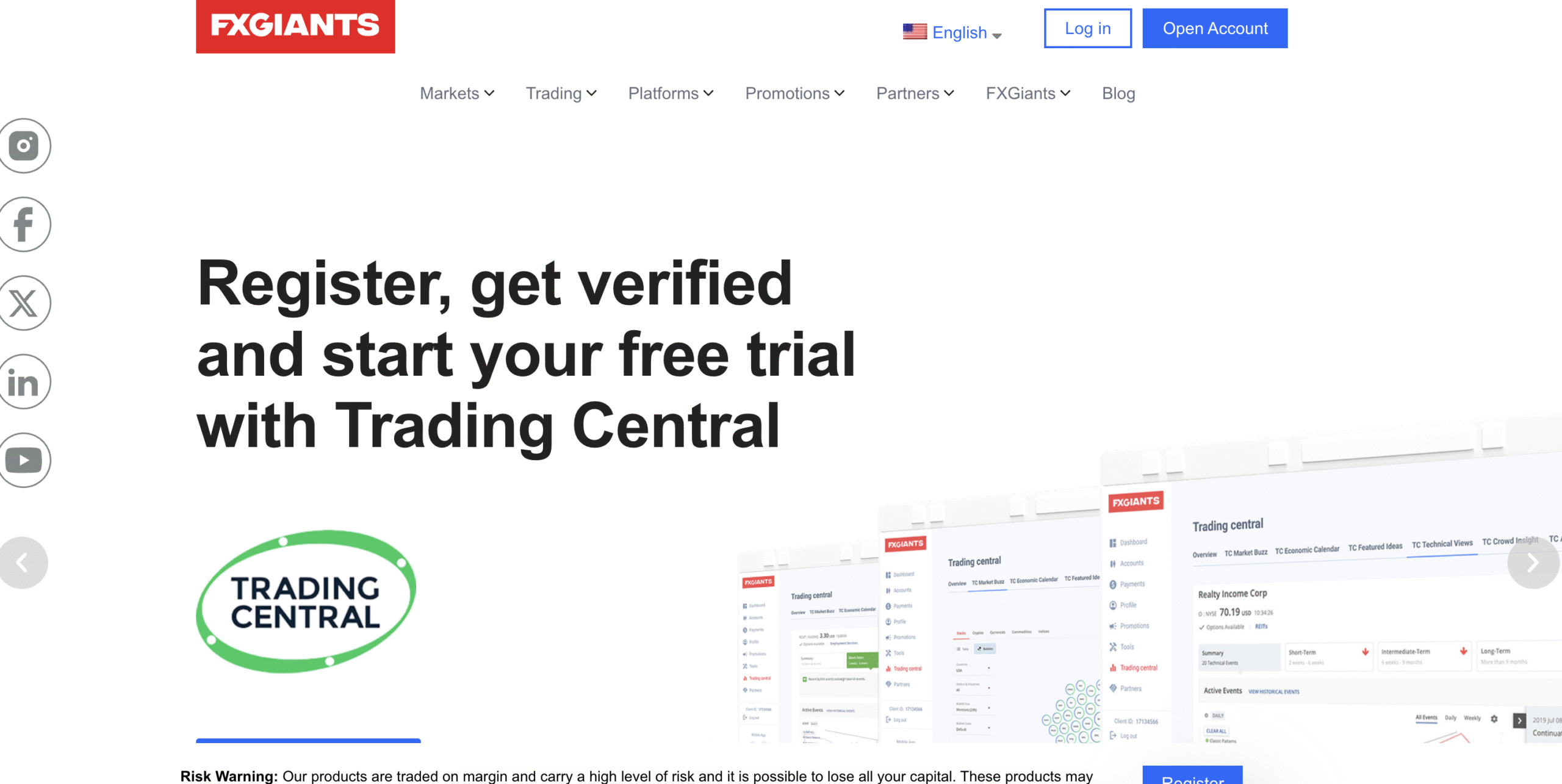
FXGiants.com arrives with all the cues of a contemporary brokerage. The interface is composed. The language is measured. MetaTrader 4 launches without resistance, and the charts behave exactly as experienced traders expect them to. Nothing in the opening minutes suggests disorder. Nothing feels improvised. For many users, that first impression becomes the lens through which everything else is judged.
Yet platforms are not defined by how they behave during calm conditions. They are defined by what happens when pressure enters the system—when spreads widen, when volatility compresses reaction time, when a user asks a simple question: Which legal system actually governs my account?
That is where FXGiants becomes interesting. Not because it is uniquely flawed, but because its structure reveals a broader truth about modern online brokers: surface unity can conceal structural divergence.
FXGiants operates through more than one legal body. One arm exists offshore in the British Virgin Islands. Another functions in the United Kingdom under the supervision of the Financial Conduct Authority. The interface does not change between these worlds. The branding does not shift. The onboarding language remains uniform. Two traders can open accounts on what appears to be the same website and exist under entirely different regulatory realities.
That difference is not cosmetic. It is architectural.
The Hidden Geography of Your Account
Many traders assume that a recognizable brand implies uniform rules. In global brokerage, that assumption dissolves quickly. A platform can be tightly regulated in one jurisdiction and lightly governed in another while presenting a single visual identity. The risk does not lie in the existence of multiple entities. It lies in how rarely users understand which one they belong to.
Understanding how platforms are authenticated across regions is not intuitive. For readers unfamiliar with this terrain, a concise guide on how brokers are independently verified offers a practical framework. It shows how jurisdiction, licensing, and client categorization quietly shape a trader’s rights long before the first order is placed.
In practice, the FXGiants experience often begins smoothly:
-
Account creation is fast
-
Platform access is immediate
-
The MT4 environment feels familiar
-
Early trades execute as expected
For many, this confirms what the marketing suggests: this is a professional-grade space.
Then friction appears.
It may start with something small. A spread widens beyond expectation during a volatile session. A stop executes several pips away from its intended level. Support replies, but slowly, with language that feels procedural rather than explanatory. None of this is catastrophic. All of it is cumulative.
Trading is a discipline of micro-decisions. When the environment becomes unpredictable, behavior changes. Traders hesitate. They second-guess. They adjust position sizing not because strategy demands it, but because trust has thinned.
This is not a technical failure. It is a behavioral one.
How Platforms Shape Trader Psychology
Platforms do more than host orders. They shape posture.
-
Execution quality influences confidence
-
Withdrawal flow influences risk appetite
-
Interface latency alters entry timing
-
Support responsiveness affects emotional load
Over time, these subtleties become performance variables.
FXGiants offers multiple account types—standard, zero-spread, hybrid—each with its own internal economics. On paper, this is flexibility. In practice, it introduces a second layer of interpretation:
-
Which account truly suits a given strategy?
-
Which cost structure reveals itself only after volume increases?
-
Which conditions change under volatility?
Some users report that what appears efficient at low volume becomes expensive at scale. Others note that promotional structures reshape behavior in ways they did not anticipate. Incentives encourage activity. Activity increases exposure. Exposure magnifies the effect of every operational inconsistency.
Bonus structures deserve particular scrutiny. They are often framed as capital enhancement. In reality, they are conditional frameworks that redefine how and when funds can be accessed. Turnover requirements, position limits, and withdrawal thresholds convert what appears to be a gift into a behavioral contract.
The contract is rarely read with the same attention as a trade setup.
Execution Isn’t Just Technical
Execution complaints exist across the industry. Slippage happens everywhere. Spreads expand under stress on every platform. The question is not whether these events occur, but how consistently they occur and how transparently they are explained.
Some FXGiants users describe patterns rather than incidents:
-
Repeated divergence between expected and executed price during specific sessions
-
Inconsistent spread behavior around scheduled news
-
Difficulty reconciling order history with market context
They describe moments where the platform feels less like a neutral intermediary and more like an opaque environment. Opacity changes posture. Traders begin to second-guess not just the market, but the medium itself.
Operational experience extends beyond the chart. Identity verification can stall. Account classification may not be clearly communicated. Requests for clarification may travel slowly through support channels. Each delay is minor in isolation. Together, they create narrative tension.
This tension becomes visible during withdrawal.
For many traders, the withdrawal process is the only moment when a platform’s internal logic is fully revealed. Deposits are frictionless across the industry. Exits are diagnostic. They expose the actual boundary between user and institution.
Some FXGiants users describe routine withdrawals. Others recount elongated timelines, shifting requirements, or balance discrepancies that require extended correspondence. These stories are not uniform. They are fragmented. That fragmentation itself becomes data.
In platforms with singular regulatory identity, inconsistency is easier to diagnose. In dual-structure systems, uncertainty persists longer. Users are not always certain which entity they belong to, which policy governs them, or which external body has jurisdiction if a dispute emerges.
When operational issues escalate, knowing the steps traders take after a platform breakdown can prevent reactive decisions. Orientation matters. So does timing.
Experiential Sameness, Legal Divergence
A unique aspect of FXGiants’ structure is how seamlessly its parallel systems are presented as one experience. The interface does not change across jurisdictions. The branding remains constant. The copy remains uniform. Yet the legal substrate beneath the interface is bifurcated.
This is not inherently deceptive. Many global brokers operate similarly. The risk emerges when users conflate visual coherence with regulatory coherence.
Markets punish assumption.
The platform’s educational content emphasizes opportunity. Less space is given to structural explanation. New users are more likely to learn about pip values than jurisdictional boundaries. This asymmetry shapes expectations.
Consider two hypothetical traders:
Trader A
-
Opens an account under the UK entity
-
Trades conservatively
-
Withdraws quarterly
-
Encounters a support issue that resolves within regulated frameworks
Trader B
-
Opens an account under the offshore entity
-
Trades actively
-
Participates in promotions
-
Encounters a delayed withdrawal
-
Finds resolution pathways less defined
Both believe they are using “FXGiants.” Only one is operating under the same institutional safeguards.
This is the platform’s most consequential dynamic: experiential sameness masking legal divergence.
From a behavioral perspective, this creates what psychologists call context collapse. The mind merges two environments into one mental model. Risk is mispriced because the environment is misperceived.
A Practical Lens for Evaluating FXGiants.com
The solution is not fear. It is literacy.
Traders benefit from mapping platforms the way institutions do: by structure, not by surface.
A simple evaluation checklist looks like this:
-
Which legal entity holds my account?
-
In which jurisdiction is that entity registered?
-
Who arbitrates disputes for this entity?
-
What mechanisms exist if communication stalls?
-
Are promotions altering my trading behavior?
-
Have I tested withdrawals early and at scale?
A trader approaching FXGiants with structural awareness operates differently. They confirm their entity. They test withdrawals early. They read incentive terms as behavioral contracts. They monitor execution patterns over time, not incidentally.
They treat the platform as an environment, not a promise.
FXGiants is not a singular experience. It is a layered system. Some layers perform reliably. Others introduce ambiguity. The platform can function smoothly for long stretches. It can also become frictional in ways that are difficult to predict from the outside.
This does not make every interaction adverse. It does make blind trust inefficient.
The most costly errors in trading are rarely technical. They are contextual. They arise when the mental model of a system diverges from its actual mechanics.
FXGiants presents a professional surface. Beneath it lies a dual framework that rewards those who map it and confounds those who assume uniformity. The platform is neither a villain nor a savior. It is an instrument whose consequences depend on how well it is understood.
Markets already demand discipline. Platforms demand orientation.
Traders who endure long enough learn that performance is not only about entries and exits. It is about the architecture within which those decisions unfold. Understanding that architecture is not optional. It is part of the craft.
And craft, in the end, is what separates participation from longevity.