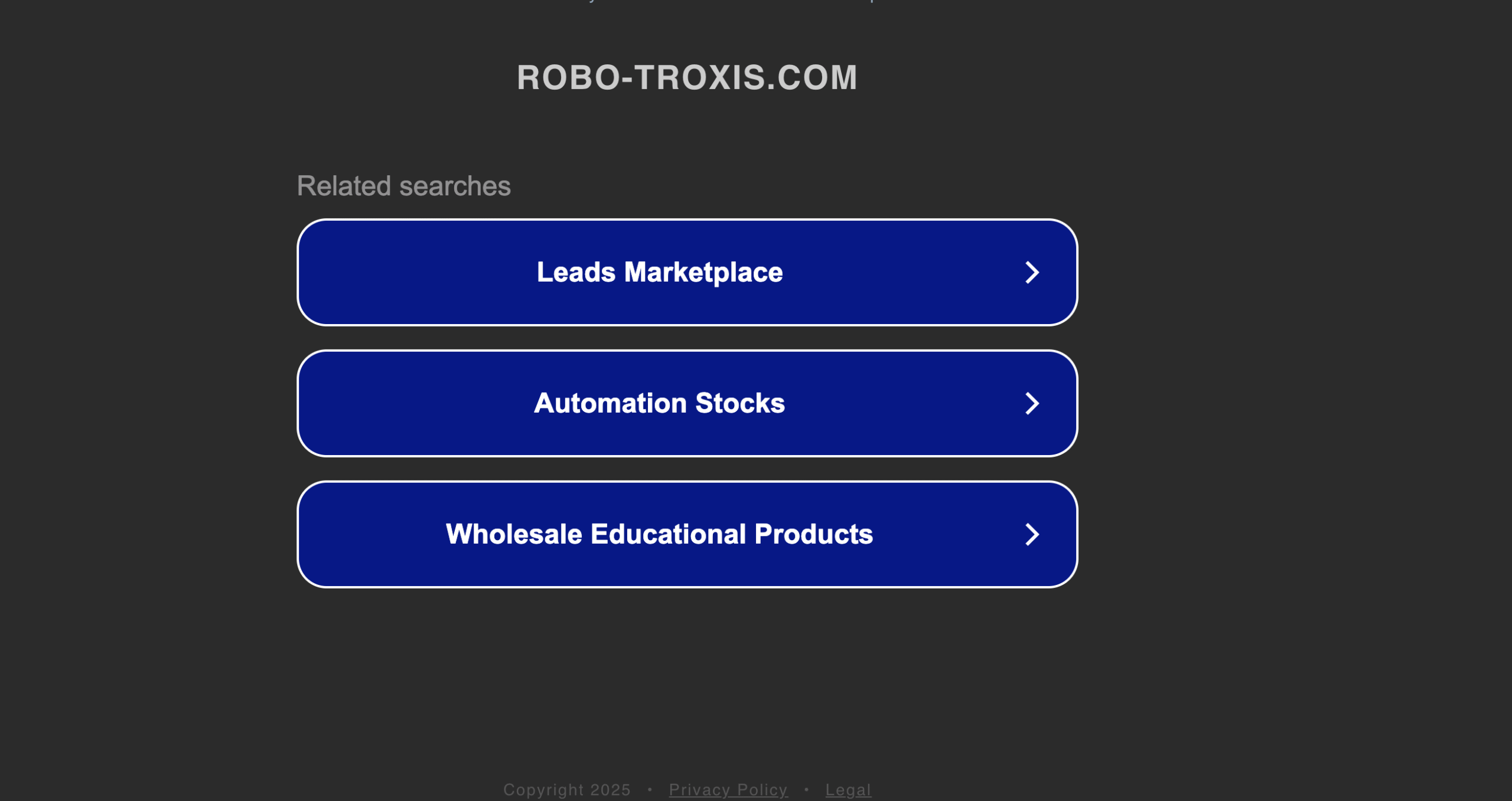
In the ever-expanding world of online investments, new platforms appear almost daily, each promising effortless profits through “automated trading,” “AI-powered algorithms,” or “crypto arbitrage systems.” Unfortunately, many of these are nothing more than sophisticated traps designed to separate unsuspecting users from their money.
One such platform that has recently drawn attention is Robo-Troxis.com. At first glance, it appears to be a sleek investment site that claims to use advanced technology to generate consistent profits. Yet, beneath this polished surface lies a maze of red flags, false promises, and user complaints.
This article takes a deep and comprehensive look at Robo-Troxis.com, examining how it operates, what investors are saying, and why it displays all the classic hallmarks of an online investment scam.
Automation has become one of the most persuasive narratives in modern investing. Platforms that claim to replace human decision-making with algorithms often promise consistency, speed, and emotional detachment from risk. Robo-Troxis.com positions itself squarely within this narrative, presenting an image of precision-driven investing powered by advanced systems.
Yet credibility in financial services is not established by terminology or interface design. It is built through verifiable structure, accountability, and operational clarity. When those elements are missing, automation becomes a story rather than a safeguard.
This deep-dive examines seven structural signals embedded in Robo-Troxis.com that materially shape user outcomes. Rather than relying on labels or slogans, the analysis focuses on observable mechanics—how the platform presents itself, how it interacts with users, and how capital actually moves within its environment.
1. Naming Strategy Built on Technological Authority
The platform’s name is not accidental. “Robo” implies automation and efficiency. “Troxis” sounds technical, abstract, and proprietary. Together, they create a sense of engineered sophistication without revealing anything concrete.
This linguistic framing is a common trust accelerator. It allows a platform to imply advanced capability without disclosing methodology, auditability, or oversight. Users are encouraged to believe the system is complex enough that questioning it would be unnecessary—or impossible.
In legitimate automated trading environments, transparency accompanies complexity. Strategies are documented, risks are disclosed, and performance claims are contextualized. Robo-Troxis.com substitutes explanation with implication, which is a meaningful structural distinction.
2. Domain Freshness and Disposable Infrastructure
Robo-Troxis.com operates on a recently registered domain with no long-term operational footprint. This matters more than many users realize.
Short-lived domains reduce reputational exposure. When complaints accumulate or payment disputes emerge, the platform can simply disappear and re-emerge under a new name. There is no legacy infrastructure to protect, no brand equity at risk.
Regulatory bodies and consumer protection agencies consistently highlight domain age as a primary contextual signal when evaluating online financial platforms, including guidance published by the UK’s Financial Conduct Authority on identifying risky online investment setups.
A system designed for permanence behaves differently from one designed for replacement.
3. Absence of a Verifiable Operating Entity
A defining feature of Robo-Troxis.com is the lack of a traceable operating company. There is no confirmed jurisdiction, no registration number, and no identifiable management.
This is not a cosmetic omission. Without a legal entity:
-
Contractual obligations are unclear
-
Dispute resolution mechanisms do not exist
-
Regulatory oversight is functionally impossible
Users encountering withdrawal friction or account restrictions have no counterparty to escalate issues to. This is why platform verification tools—such as those outlined in guides on how to verify online investment platforms—place such heavy emphasis on corporate traceability.
Structure determines accountability. Here, accountability is structurally absent.
4. Interface-Led Confidence Without Independent Proof
Robo-Troxis.com relies heavily on dashboards, performance figures, and internal account balances to establish confidence. These visual elements are persuasive, but they are not independently verifiable.
There is no linkage to:
-
Public transaction explorers
-
Third-party custody confirmations
-
External audits or reconciliations
As a result, users must trust that the numbers displayed correspond to real activity. In legitimate automated environments, users are encouraged to validate performance externally. Here, validation is impossible by design.
This dynamic mirrors patterns described in broader crypto safety resources, where interface-driven certainty replaces evidence-based verification.
5. Withdrawal Logic That Evolves After Deposit
One of the most consequential signals reported by users involves changing conditions around fund access. Initial deposits are accepted seamlessly. Friction appears later—often when withdrawal requests are submitted.
Users describe new requirements emerging at that stage:
-
Additional verification thresholds
-
Account “unlock” conditions
-
Administrative or processing charges
The sequencing matters. Conditions introduced after capital commitment fundamentally alter the risk profile. In regulated environments, withdrawal terms are defined upfront and remain stable.
Consumer protection authorities, including Action Fraud UK, have repeatedly warned about post-deposit conditions as a recurring pattern in high-loss online investment environments.
6. Communication That Narrows Over Time
Early-stage communication with Robo-Troxis.com is often described as responsive and attentive. This changes as user requests become more specific or financially sensitive.
Over time, reports indicate:
-
Slower response times
-
Generic or scripted replies
-
Complete communication drop-off
This narrowing communication funnel benefits only one side. Users are guided efficiently toward funding actions, but left isolated when seeking clarification or resolution.
Resources designed to support individuals after financial disputes—such as guidance on what steps to take after losing funds online—frequently identify communication collapse as a decisive moment in recognizing structural imbalance.
7. One-Way Risk Allocation
The final signal is how risk is distributed. Robo-Troxis.com appears to externalize nearly all downside exposure to the user.
Funds are typically transferred through mechanisms that:
-
Offer no reversal
-
Lack third-party mediation
-
Depend entirely on platform cooperation
Once capital enters the system, control effectively shifts away from the user. Combined with anonymous operation and mutable conditions, this creates a one-way risk channel.
In sustainable financial models, risk is shared, disclosed, and mitigated. Here, it is transferred.
Pattern Alignment: Why These Signals Reinforce Each Other
Each signal alone raises concern. Together, they form a coherent operational picture:
-
Authority implied through naming
-
Flexibility preserved through disposable infrastructure
-
Accountability avoided through anonymity
-
Confidence engineered through interfaces
-
Control enforced through evolving conditions
This alignment is structural, not incidental.
Broader Context: Why Platforms Like This Persist
Robo-Troxis.com exists within a wider ecosystem shaped by low barriers to entry, global payment rails, and uneven regulatory coverage. Automation narratives and crypto volatility amplify user willingness to suspend skepticism.
Educational hubs focused on asset protection in digital finance consistently emphasize that structural awareness—not optimism—is the most reliable defense.
Closing Perspective
Robo-Troxis.com demonstrates how risk can be embedded quietly, long before a user experiences a visible problem. The platform’s structure prioritizes intake, flexibility, and opacity over durability and accountability.
In online investing, outcomes are rarely determined by promises. They are shaped by design choices. Recognizing those choices early is not pessimism—it is discipline.
Missed opportunities can be revisited. Structural losses rarely can.