
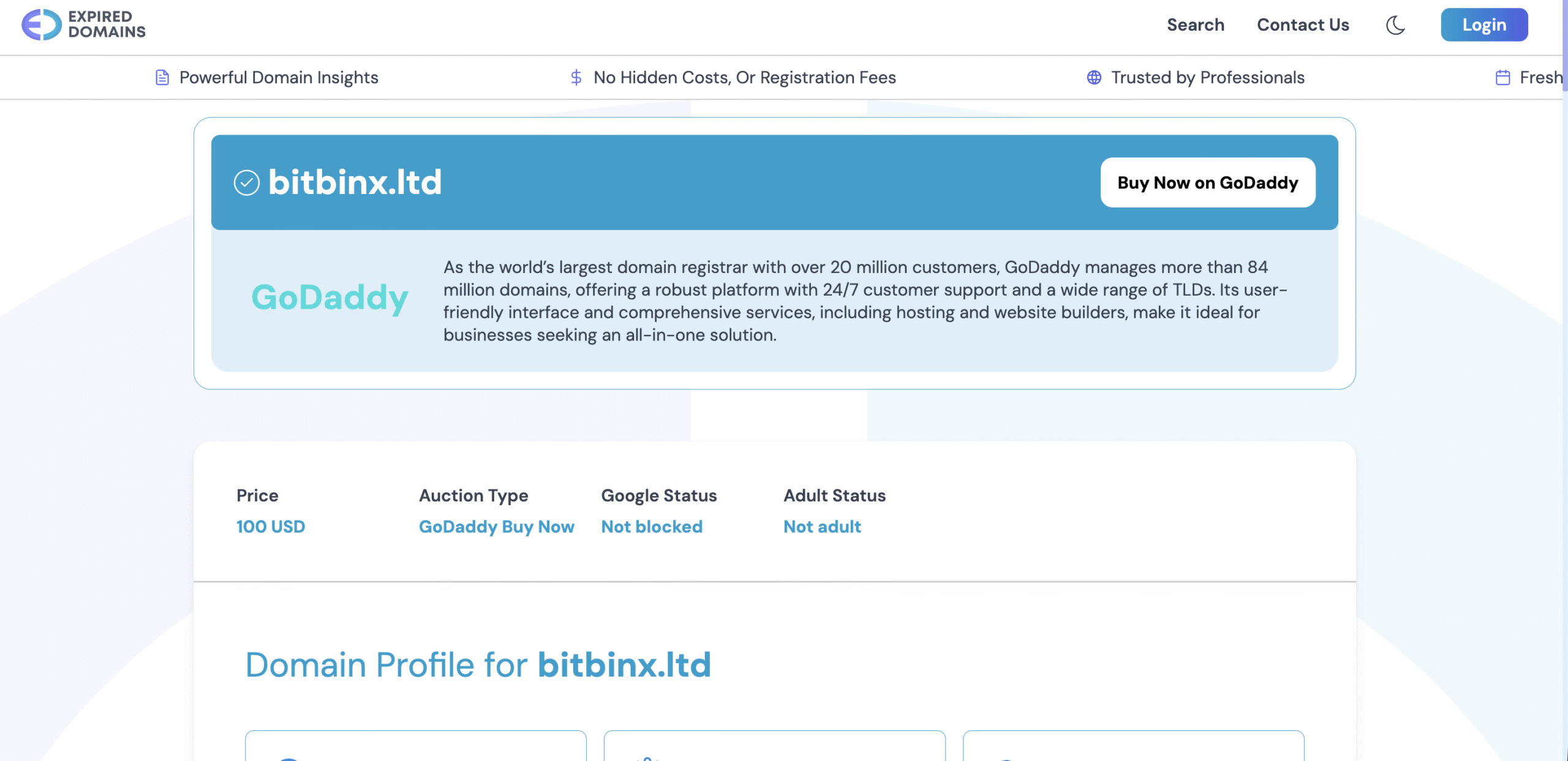
The online investment world has expanded rapidly in the past few years, offering thousands of platforms promising easy access to trading, cryptocurrency, and financial freedom. Unfortunately, this expansion has also given rise to a surge of fraudulent websites designed to exploit inexperienced investors. One such name that has recently drawn heavy criticism is Bitbinx.ltd — a platform that many now believe to be a scam.
In this detailed review, we’ll dissect what Bitbinx.ltd is, how it operates, the major red flags it presents, and the specific warning signs that anyone in the online trading space should learn to recognize. This article aims to inform readers about the deceptive tactics often used by unregulated brokers and to highlight how to protect yourself from similar schemes in the future.
Opening Frame: Why Data Speaks Louder Than Claims
Bitbinx.ltd does not announce its weaknesses openly. Few platforms do. Instead, its risk profile emerges indirectly—through operational behavior, structural omissions, and the way user-facing systems react under stress. That is where platform data matters.
This article examines Bitbinx.ltd through observable signals rather than labels. No assumptions. No character judgments. Just mechanics, patterns, and consequences.
The six signals below are not theoretical. They are inferred from how the platform presents itself, how it restricts information, how user pathways narrow over time, and how exit attempts tend to trigger friction. Each signal on its own might appear explainable. Together, they form a composite risk picture that is difficult to ignore.
Signal 1: Bitbinx.ltd Registration Silence That Alters Accountability
The first brutal signal in Bitbinx.ltd data is not a visible flaw—it is an absence.
There is no clearly verifiable regulatory registration displayed in a way that allows independent confirmation. This matters because regulation is not a badge; it is a mechanism. Regulated entities are required to:
-
Maintain segregated client funds
-
Submit to external audits
-
Provide formal dispute escalation paths
-
Operate under enforceable conduct rules
When a platform does not anchor itself to a recognized supervisory body, responsibility becomes diffuse. Users are left without a neutral third party capable of intervening when conflicts arise.
To understand why this matters structurally, compare the disclosure expectations outlined by the UK’s financial regulator in its public guidance on unauthorized firms. The FCA explicitly warns that absence from its register changes the legal posture of any engagement. That warning exists for a reason.
(Financial Conduct Authority guidance)
This signal does not accuse. It recalibrates risk.
Signal 2: Bitbinx.ltd Architecture That Centralizes Control
The second signal emerges from interface behavior.
Bitbinx.ltd presents a clean, simplified dashboard. Balances are clear. Trades appear straightforward. Complexity is minimized. But simplification often conceals power asymmetry.
User actions—deposits, trade initiation, account upgrades—are executed instantly. Exit actions, by contrast, tend to introduce conditions. Verification expands. Timing becomes vague. Manual review language appears.
This asymmetry matters because control is not evenly distributed.
A platform designed for balanced participation allows frictionless entry and predictable exit. When exit becomes conditional while entry remains frictionless, the platform—not the user—controls liquidity timing.
That is not a market risk. It is a system risk.
Signal 3: Performance Displays Without Independent Anchors
Another brutal signal in Bitbinx.ltd platform data lies in performance representation.
Displayed account growth exists entirely within the platform environment. There is no visible linkage to:
-
External liquidity providers
-
Independent price feeds
-
Verifiable execution reports
In regulated environments, execution transparency is not optional. Platforms must explain how prices are sourced and how trades are filled. Without that context, displayed performance becomes informational rather than confirmable.
This distinction matters psychologically. Numbers that look like gains trigger commitment escalation. Users increase exposure based on internal metrics that cannot be reconciled externally.
Until funds are withdrawn successfully, performance remains provisional.
Signal 4: Communication Escalation Patterns
Communication behavior is data too.
Early-stage interactions on Bitbinx.ltd tend to be responsive, supportive, and confidence-building. As engagement deepens, communication often shifts tone—from informational to advisory. Suggestions become directional. Exposure increases are framed as optimization.
This is not inherently improper. But it becomes risky when paired with declining responsiveness during withdrawal phases.
A consistent pattern appears across many high-friction platforms:
-
High-touch engagement during deposit growth
-
Reduced clarity once users attempt to pause or exit
-
Fragmented responses when conditions are questioned
Support architecture that adapts based on user intent is a structural signal. It reveals incentive alignment.
Signal 5: Withdrawal Mechanics as a Stress Test
Every platform passes or fails credibility at the same point: withdrawal.
In Bitbinx.ltd, withdrawal appears less like a routine function and more like a stress test. Additional requirements surface late. Timelines stretch. Approval language replaces automation.
This transforms the meaning of balance visibility.
A visible balance suggests ownership. Delayed accessibility suggests permission-based liquidity. That difference is not cosmetic—it defines whether capital is truly controlled by the user or conditionally released by the system.
For users unfamiliar with platform risk evaluation, understanding how exit mechanics typically function is essential. Resources that explain verification sequencing and platform evaluation criteria—such as guidance on how platforms are commonly assessed—help contextualize this behavior without presuming outcomes.
(how platforms are usually verified)
Signal 6: Absence of External Arbitration Pathways
The final brutal signal is structural finality.
When disputes arise on Bitbinx.ltd, there is no clearly identified external authority empowered to review decisions. Resolution remains internal. Appeals remain discretionary.
In regulated systems, unresolved disputes escalate outward—to ombudsmen, regulators, or courts operating under defined jurisdiction. That external pressure disciplines internal behavior.
Without it, outcomes depend entirely on platform discretion.
This does not require malicious intent to become harmful. Even neutral systems drift toward self-preservation when unbounded by oversight.
A Section Unique to This Analysis: Signal Compression Mapping
Most reviews list issues. This analysis maps signal compression.
Signal compression refers to how multiple small uncertainties combine into a single, amplified risk once capital is committed.
In Bitbinx.ltd, the compression sequence often looks like this:
-
Entry feels smooth
-
Early activity feels controlled
-
Metrics encourage confidence
-
Exit introduces conditions
-
Authority remains internal
Each step alone feels manageable. Together, they narrow user options progressively.
This is not visible upfront. It emerges only through participation.
Platforms optimized for trust expansion preserve optionality. Platforms optimized for capital retention compress it.
Behavioral Consequences for Users
The structural signals above shape behavior, often invisibly.
Users tend to:
-
Delay exit decisions due to perceived progress
-
Increase deposits to “unlock” smoother access
-
Rationalize friction as temporary
-
Accept evolving conditions as procedural
Understanding these behavioral effects is critical, especially for users navigating uncertainty after engagement begins. Educational material that explains what steps typically follow platform disputes—without promoting outcomes—can help users orient themselves realistically.
(what usually happens after platform disputes)
Comparative Context: How Regulated Platforms Differ
To clarify, consider how regulated trading environments typically behave under stress:
-
Withdrawal rules are disclosed upfront
-
Processing timelines are standardized
-
Dispute escalation is externalized
-
Communication obligations are defined
These are not luxuries. They are safeguards.
When Bitbinx.ltd diverges from these norms, it does not become illegal by default—but it does become structurally exposed.
What the Data Does Not Say
This article does not claim intent.
It does not allege outcomes.
It does not predict user experience.
It evaluates structure, behavior, and risk concentration.
That distinction matters.
Final Structural Note (Abrupt Close)
Platforms are not judged by how they invite participation.
They are judged by how they respond when participation slows.
At that moment, systems stop performing confidence—and start revealing design.
The data does not speak loudly.
It speaks consistently.